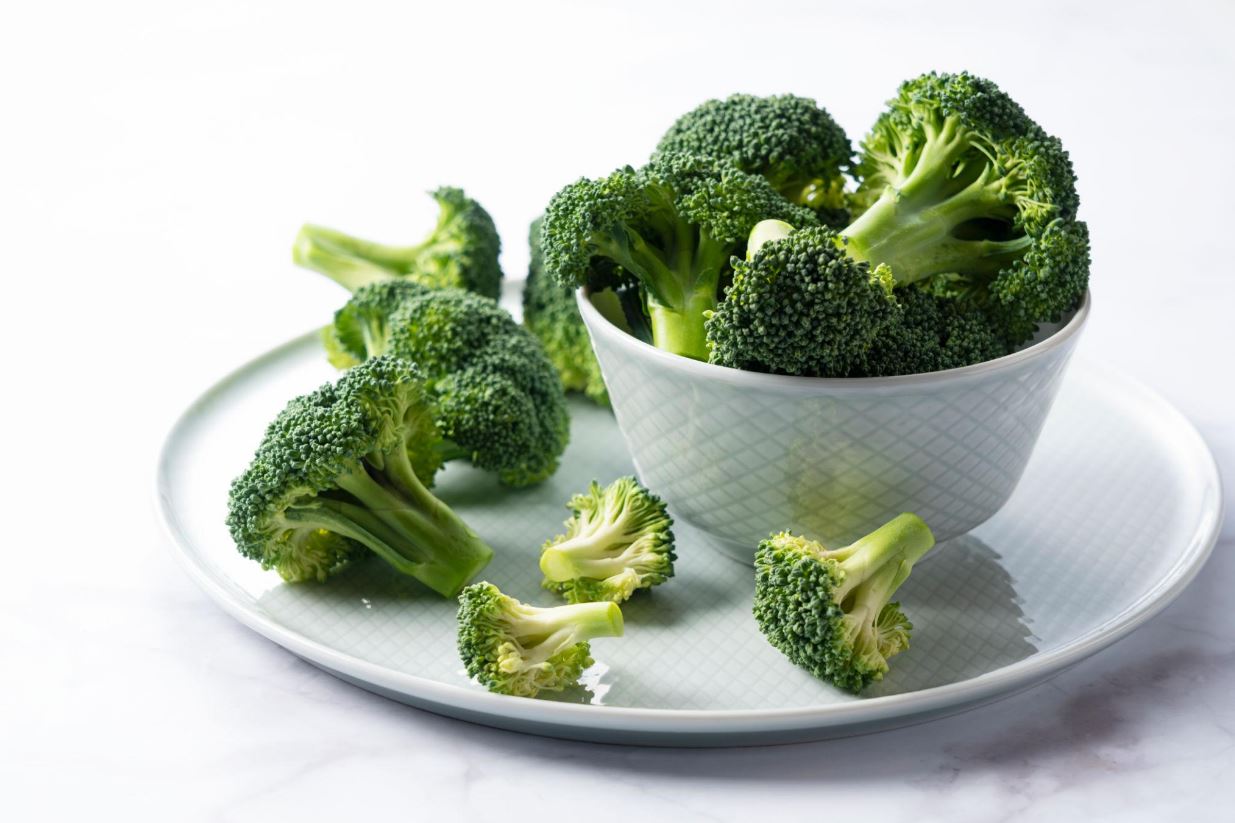
Broccoli Nutrition Facts: Calories, Protein, Carbs, Vitamins and Health Benefits
Broccoli contains approximately 34 calories, 2.82 grams of protein, 6.64 grams of total carbohydrates and 2.6 grams of dietary fiber per 100 grams when raw, according to the U.S. Department of Agriculture's food-composition data.
It is also a valuable source of vitamin C, vitamin K, folate and several naturally occurring plant compounds.
A 100-gram portion of raw broccoli supplies approximately 89.2 milligrams of vitamin C, 101.6 micrograms of vitamin K and 316 milligrams of potassium.
Cooking changes these numbers. For example, 100 grams of plain boiled, drained broccoli contains approximately 35 calories, 2.38 grams of protein and 3.3 grams of fiber in the USDA reference data.
But calories and macronutrients are only part of broccoli's nutritional profile.
Broccoli belongs to the cruciferous vegetable family and contains glucosinolates, plant compounds studied for their potential effects on human health.
This guide explains broccoli nutrition facts per 100g and per serving, the differences between raw and cooked broccoli, its vitamins and minerals, potential health benefits, and how to prepare it while retaining useful nutrients.
Broccoli Nutrition Facts per 100g
The following table uses USDA FoodData Central data for raw broccoli and broccoli that has been boiled, drained and prepared without added salt.
Both columns describe 100 grams of the edible food.
Raw vs. Cooked Broccoli Nutrition Chart
| Nutrient | Raw broccoli, 100g | Boiled broccoli, 100g |
|---|---|---|
| Calories | 34 kcal | 35 kcal |
| Protein | 2.82 g | 2.38 g |
| Total carbohydrates | 6.64 g | 7.18 g |
| Dietary fiber | 2.60 g | 3.30 g |
| Total sugars | 1.70 g | 1.39 g |
| Total fat | 0.37 g | 0.41 g |
| Vitamin C | 89.2 mg | 64.9 mg |
| Vitamin K | 101.6 µg | 141 µg |
| Folate | 63 µg | 108 µg |
| Potassium | 316 mg | Varies by preparation |
Data sources: USDA FoodData Central SR Legacy records Broccoli, raw (FDC 170379) and Broccoli, cooked, boiled, drained, without salt (FDC 169967).
These are food-composition reference values, not a measurement of the exact broccoli on your plate.
Cooking changes water content, nutrient concentration and sometimes nutrient retention.
Important: A higher fiber or vitamin K value per 100 grams of cooked broccoli does not necessarily mean cooking creates more of that nutrient. A cooked 100-gram portion can represent a different amount of original raw vegetable because of changes in water and weight.
How Many Calories Are in Broccoli?
Broccoli is a relatively low-calorie vegetable.
According to USDA food-composition data:
| Broccoli portion | Approximate calories |
|---|---|
| 50g raw broccoli | 17 |
| 80g raw broccoli | 27 |
| 100g raw broccoli | 34 |
| 1 cup chopped raw broccoli (91g) | 31 |
| 150g raw broccoli | 51 |
| 200g raw broccoli | 68 |
| 100g plain boiled broccoli | 35 |
These figures apply to plain broccoli without added cooking fats or sauces.
If you roast broccoli with olive oil, for example, the final dish contains calories from both the broccoli and the oil.
Broccoli served with cheese sauce, butter, breadcrumbs or other ingredients will also have a different nutritional profile.
Does Steaming Broccoli Add Calories?
Steaming without added fat does not introduce a meaningful additional source of calories.
However, the weight of broccoli may change as it cooks.
For accurate food tracking, use the nutritional record matching the form you weigh: raw, steamed or boiled.
How Much Protein Is in Broccoli?
Raw broccoli contains approximately 2.82 grams of protein per 100 grams.
Plain boiled broccoli contains approximately 2.38 grams per 100 grams in the USDA reference record.
These quantities are useful contributions, but broccoli is not a concentrated protein food.
For comparison, protein-rich foods such as lentils, beans, tofu, eggs, fish and meat generally provide more protein per typical serving.
Broccoli Protein by Portion
| Raw broccoli | Approximate protein |
|---|---|
| 50g | 1.41 g |
| 80g | 2.26 g |
| 100g | 2.82 g |
| 150g | 4.23 g |
| 200g | 5.64 g |
The calculations use the USDA raw-broccoli value of 2.82 grams of protein per 100 grams.
Is Broccoli a Good Source of Protein for Vegetarians?
Broccoli can contribute to a vegetarian or vegan eating pattern, but it should not be the main source of protein.
A useful meal might combine broccoli with tofu, beans, lentils or another suitable protein-containing food.
This provides broccoli's fiber and micronutrients alongside a more substantial protein source.
How Many Carbs Are in Broccoli?
Raw broccoli contains approximately 6.64 grams of total carbohydrates per 100 grams in the USDA record.
Of these, approximately 2.6 grams are dietary fiber.
The carbohydrate content is relatively modest compared with starchy vegetables such as potatoes and sweet corn.
Broccoli Carbs by Weight
| Raw broccoli portion | Total carbohydrates | Fiber |
|---|---|---|
| 50g | 3.32 g | 1.30 g |
| 80g | 5.31 g | 2.08 g |
| 100g | 6.64 g | 2.60 g |
| 150g | 9.96 g | 3.90 g |
| 200g | 13.28 g | 5.20 g |
These values come from multiplying the USDA per-100-gram figures by the portion weight.
What About Net Carbs?
In some U.S. dietary discussions, net carbs refers to total carbohydrates minus dietary fiber.
Using that informal calculation:
6.64g total carbs − 2.60g fiber = approximately 4.04g net carbs per 100g of raw broccoli.
Net carbs is not a universally standardized nutrition-label measurement.
UK food databases generally report available carbohydrates differently from the USDA's total-carbohydrate-by-difference measure.
Consequently, you should not directly compare U.S. total-carbohydrate figures with UK available-carbohydrate figures without understanding the different definitions.
Is Broccoli High in Fiber?
Broccoli provides dietary fiber, although the quantity depends on the portion and preparation.
Raw broccoli contains about 2.6 grams of fiber per 100 grams.
Cooked broccoli contains about 3.3 grams per 100 grams in the selected USDA boiled-and-drained record.
Fiber helps support normal bowel function and contributes to a healthy overall diet.
Some dietary fiber can also be fermented by gut microorganisms.
Does Broccoli Help With Constipation?
Broccoli can contribute to a fiber-rich diet, but it is not a guaranteed treatment for constipation.
The response to dietary fiber varies.
Adequate fluid intake, activity, medical conditions and other aspects of the diet also influence bowel function.
People who experience bloating after eating broccoli may find smaller portions or cooked preparations easier to tolerate.
Increasing fiber gradually can be more comfortable than making a sudden large change.
Vitamins in Broccoli
One of broccoli's greatest nutritional advantages is its vitamin content.
It provides particularly useful amounts of vitamin C and vitamin K, together with folate and other micronutrients.
Vitamin C: 89.2mg per 100g Raw
Vitamin C supports collagen formation, normal immune function and the absorption of nonheme iron from plant-based foods.
The USDA lists approximately 89.2 milligrams of vitamin C in 100 grams of raw broccoli.
Cooking can reduce vitamin C content because vitamin C is sensitive to heat and can dissolve into cooking water.
The National Institutes of Health lists approximately 51 milligrams of vitamin C in half a cup of cooked broccoli.
This is a useful amount from a familiar everyday vegetable.
Vitamin K: 101.6µg per 100g Raw
Vitamin K is involved in normal blood clotting.
Broccoli also provides vitamin K in quantities that can make a meaningful contribution to dietary intake.
The USDA raw-broccoli record lists about 101.6 micrograms per 100 grams.
Vitamin K is fat-soluble, and its availability depends partly on the overall meal.
People taking warfarin should maintain a consistent intake of vitamin K-containing foods and seek guidance from their anticoagulation team.
Folate: 63µg per 100g Raw
Folate is a B vitamin involved in DNA synthesis and normal cell division.
The USDA record reports approximately 63 micrograms of folate per 100 grams of raw broccoli.
Folate is especially important during periods of growth and pregnancy.
However, broccoli should not be treated as a substitute for clinically recommended folic acid supplementation.
Other Vitamins
Broccoli also contains smaller amounts of vitamin B6, riboflavin, vitamin E and provitamin A carotenoids.
No single food supplies every vitamin and mineral in adequate quantities.
Broccoli is most useful as one component of a varied diet.
Minerals in Broccoli
Broccoli contributes several essential minerals.
Broccoli Mineral Chart: Raw, per 100g
| Mineral | Amount |
|---|---|
| Potassium | 316 mg |
| Calcium | 47 mg |
| Phosphorus | 66 mg |
| Magnesium | 21 mg |
| Iron | 0.73 mg |
| Sodium | 33 mg |
| Zinc | 0.41 mg |
Source: USDA FoodData Central, raw broccoli, FDC 170379.
Potassium contributes to normal muscle and nerve function.
Calcium and phosphorus are important components of bones and teeth.
Magnesium and iron participate in numerous physiological functions.
However, broccoli is not a replacement for all other mineral sources.
For example, it contributes some calcium, but most people need other appropriate dietary sources to meet their overall requirements.
Broccoli Health Benefits: What Does the Research Actually Show?
Broccoli provides nutrients that contribute to a healthy dietary pattern.
It is also a cruciferous vegetable, which makes it of particular interest in nutrition research.
However, the evidence should be interpreted carefully.
1. Supports a Nutrient-Dense Diet
Broccoli combines relatively few calories with vitamin C, vitamin K, folate, fiber and other nutrients.
This makes it a practical addition to many balanced meals.
It can be steamed, roasted, added to soup or included in stir-fries.
2. Contributes to Digestive Health
Broccoli contains dietary fiber that can help support normal bowel function.
Its fiber forms part of a broader plant-food intake that may influence gut microbial activity.
However, eating broccoli alone does not guarantee a specific change in the gut microbiome.
3. Contributes to Normal Immune Function
The vitamin C in broccoli supports normal immune system function.
This does not mean broccoli prevents colds or cures infections.
Adequate vitamin C intake is one factor in normal physiological function.
4. Supports Normal Blood Clotting
Broccoli contains vitamin K, a nutrient necessary for normal blood clotting.
This is a nutritional function, not a reason to eat unlimited broccoli or change medications.
5. May Support Heart-Healthy Eating Patterns
Vegetables are important components of diets associated with cardiovascular health.
Broccoli contributes fiber, potassium and other nutrients, but the health benefits of a diet depend on the full eating pattern.
Replacing less nutritious meal components with suitable vegetables may improve overall dietary quality.
6. Contains Compounds Studied for Cancer Prevention
Broccoli contains glucosinolates, which can form biologically active compounds during food preparation and digestion.
These include certain isothiocyanates, such as sulforaphane.
Laboratory and animal research has identified potentially relevant biological mechanisms.
However, human evidence is mixed, and broccoli has not been established as a treatment or guaranteed preventive measure for cancer.
The U.S. National Cancer Institute explicitly distinguishes promising laboratory findings from uncertain evidence of clinical effects in people.
What Is Sulforaphane in Broccoli?
Sulforaphane is a compound formed from the glucosinolate glucoraphanin.
An enzyme called myrosinase helps convert glucoraphanin into sulforaphane when plant tissues are damaged by chopping or chewing.
Gut microorganisms may also contribute to glucosinolate breakdown.
Scientists are studying sulforaphane because of its effects on pathways involved in cellular responses to stress and other biological processes.
Does Broccoli Contain Sulforaphane Naturally?
Broccoli contains glucoraphanin, a precursor of sulforaphane.
The amount of sulforaphane formed depends on several factors, including vegetable variety, preparation method, enzyme activity and digestion.
It is therefore inaccurate to promise a fixed sulforaphane dose from an ordinary serving of broccoli.
Is Sulforaphane Proven to Prevent Cancer?
No.
The research is scientifically interesting, but results from laboratory, animal and human studies are not interchangeable.
Eating broccoli should be considered part of healthy dietary variety rather than a cancer treatment.
Raw vs. Cooked Broccoli: Which Is Better?
Both raw and cooked broccoli can be nutritious.
Raw broccoli may retain more of certain heat-sensitive nutrients and naturally active plant enzymes.
Cooking can improve texture, palatability and digestibility for some people.
Raw Broccoli
Raw broccoli can be eaten in salads or with dips after being properly washed.
It provides vitamin C, fiber and glucosinolate-related compounds.
Some people find its texture or gas-producing effects uncomfortable.
Steamed Broccoli
Steaming is a practical cooking method that uses little direct contact with water.
It can soften the vegetable while limiting losses of some water-soluble nutrients compared with prolonged boiling.
The exact effect depends on the time and temperature.
Boiled Broccoli
Boiling makes broccoli tender, but some water-soluble nutrients and plant compounds may transfer into the cooking liquid.
Longer cooking times can increase certain losses.
Broccoli boiled for soup may retain some of these nutrients in the finished meal if the cooking liquid is consumed.
Roasted Broccoli
Roasting produces browned surfaces and a different flavor.
Plain broccoli remains nutritious, but cooking with oil or other ingredients changes the nutrition facts of the finished dish.
Which Cooking Method Should You Choose?
For everyday eating, lightly steaming, microwaving with limited water, roasting and eating properly washed raw broccoli can all be reasonable options.
There is no need to insist that all broccoli must be raw or that one cooking method preserves every nutrient equally.
The most useful preparation is one that makes broccoli safe, enjoyable and easy to include regularly.
Does Cooking Broccoli Destroy Sulforaphane?
Cooking can change sulforaphane formation because plant myrosinase is sensitive to heat.
Research has shown that temperature, cooking duration and water contact can influence glucosinolate retention and isothiocyanate availability.
Boiling may also cause some glucosinolates to dissolve into cooking water.
However, these effects are not equivalent to cooking removing every potentially beneficial compound.
The gastrointestinal environment and gut microorganisms also influence what happens after consumption.
A practical approach is to avoid unnecessarily prolonged cooking while prioritizing food safety and enjoyment.
Broccoli Nutrition in the UK vs. USA
British and American readers may encounter different broccoli nutrition facts even when comparing apparently identical foods.
For example, the USDA raw-broccoli reference reports approximately 6.64 grams of total carbohydrates per 100 grams.
UK government CoFID food-composition records may report significantly lower carbohydrate figures for broccoli because they use a different carbohydrate definition, among other methodological differences.
Why the Figures Differ
In general:
USDA SR Legacy carbohydrate-by-difference values include fiber in the reported carbohydrate total.
UK food-composition tables generally present available carbohydrate separately from fiber.
Raw and cooked food entries have different amounts of water.
Food varieties and analytical methods differ.
These differences do not mean broccoli is nutritionally different simply because it was sold in another country.
For UK-specific calculations, use an appropriate CoFID record.
For U.S. product or food tracking, use a clearly identified USDA record or the applicable packaged-food Nutrition Facts label.
Does Broccoli Count Toward Your 5 A Day in the UK?
Yes.
According to the NHS, an adult portion of fruit or vegetables is approximately 80 grams.
Two broccoli spears or approximately eight broccoli florets can represent a portion, depending on their size.
Broccoli can therefore contribute toward the UK's 5 A Day target.
UK Broccoli Portion Guide
| Broccoli amount | How to interpret it |
|---|---|
| 80g | One standard adult 5 A Day portion |
| Two broccoli spears | NHS practical portion example |
| About eight florets | NHS approximate portion example |
| 160g | Roughly two 80g quantities, although dietary variety remains important |
Repeated servings of broccoli can contribute to total vegetable intake, but the NHS also encourages eating a variety of fruit and vegetables.
For children, appropriate portion sizes depend on age and individual needs.
How Much Broccoli Should You Eat Per Day?
There is no universal medically established requirement to eat broccoli every day.
You can include it as part of your overall vegetable intake.
A portion might be about 80–100 grams, depending on the meal and the dietary guidance being followed.
Some people enjoy broccoli several times per week, while others rotate it with cauliflower, cabbage, leafy greens and other vegetables.
Variety helps supply different nutrients and reduces dependence on one food.
Is Broccoli Good for Weight Management?
Broccoli can be useful in weight-management eating patterns because it provides relatively few calories per 100 grams and contributes fiber and water.
For example, plain steamed broccoli can increase the vegetable content of a meal without adding substantial energy.
However, eating broccoli itself does not cause weight loss.
Total food intake, physical activity, health conditions and other factors influence body weight.
It is also important to eat enough overall energy and protein for your needs.
Is Broccoli Suitable for People With Diabetes?
Broccoli is a non-starchy vegetable with a relatively modest carbohydrate content per typical serving.
It can fit into many eating patterns for people with diabetes.
However, carbohydrate management depends on the entire meal, medications and individual needs.
Broccoli covered in a sweet sauce or served with other carbohydrate-rich foods has a different total carbohydrate contribution from plain broccoli.
People who need medical nutrition therapy should use individualized guidance.
Can Broccoli Cause Gas or Bloating?
Yes, in some people.
Broccoli contains fiber and other fermentable carbohydrates that may contribute to gas when broken down in the digestive tract.
Some people tolerate small cooked portions more comfortably than large raw portions.
Helpful approaches may include:
Starting with smaller portions.
Cooking broccoli until tender.
Eating it as part of a balanced meal.
Increasing overall fiber gradually.
Persistent digestive symptoms deserve appropriate medical evaluation.
Can You Eat Broccoli Stems and Leaves?
Yes.
The tender edible stems, florets and appropriately prepared leaves can be eaten.
Broccoli stems are often discarded because of their firmer outer texture.
Peeling the tough exterior and slicing the tender interior makes them useful in soups, stir-fries and roasted vegetable dishes.
This can reduce food waste.
The exact nutrient composition of stems and leaves differs from the floret-heavy nutrition references, so don't assume that every part contains identical amounts of vitamins and minerals.
Fresh vs. Frozen Broccoli: Which Is More Nutritious?
Both can be nutritious choices.
Frozen broccoli is often blanched before freezing, which can affect some heat-sensitive nutrients.
However, freezing can help preserve produce for longer periods and make it more convenient to use.
Fresh broccoli's nutrient content can also change during storage.
For packaged frozen broccoli, check whether it contains added sauces, salt or other ingredients.
When exact nutritional values matter, use the specific frozen-food record or package label rather than the raw broccoli table.
How to Store and Prepare Broccoli Safely
Keep broccoli refrigerated and follow appropriate freshness and food-safety guidance.
Before preparing raw broccoli, rinse thoroughly under running water.
Do not use soap or detergent to wash produce.
Trim damaged parts and discard produce showing signs of serious spoilage.
For cooked broccoli, use normal safe refrigeration and leftover-handling practices.
Washing reduces surface contamination but does not eliminate every potential microorganism.
Is Broccoli Better Than Cauliflower?
Broccoli and cauliflower both belong to the cruciferous vegetable family.
Both can contribute vitamin C, fiber and other nutrients.
Broccoli generally provides a different combination and amount of micronutrients than cauliflower.
However, neither is universally better for every person.
Cauliflower may suit certain recipes or preferences, while broccoli may be especially attractive when vitamin C and vitamin K are priorities.
Eating both can contribute greater variety.
Frequently Asked Questions About Broccoli Nutrition Facts
How many calories are in 100g of broccoli?
Raw broccoli contains approximately 34 calories per 100 grams in USDA data.
How many calories are in cooked broccoli?
Plain boiled, drained broccoli contains approximately 35 calories per 100 grams in the USDA reference record.
How much protein is in 100g of broccoli?
Raw broccoli provides about 2.82 grams of protein per 100 grams.
Is broccoli high in protein?
Broccoli contains some protein, but it is not a concentrated protein source compared with legumes, tofu, eggs, dairy, fish or meat.
How many carbs are in broccoli?
Raw broccoli contains approximately 6.64 grams of total carbohydrates per 100 grams under the USDA carbohydrate-by-difference measure.
How many net carbs are in broccoli?
Using the informal U.S. calculation of total carbohydrates minus fiber, 100 grams of raw broccoli provides approximately 4.04 grams of net carbohydrates.
How much fiber is in broccoli?
Raw broccoli has approximately 2.6 grams of fiber per 100 grams. The USDA boiled-and-drained reference contains about 3.3 grams per 100 grams.
Is broccoli high in vitamin C?
Yes. USDA data report approximately 89.2 milligrams of vitamin C per 100 grams of raw broccoli.
Does broccoli contain vitamin K?
Yes. Raw broccoli contains approximately 101.6 micrograms of vitamin K per 100 grams.
Does broccoli contain iron?
Yes. Raw broccoli provides approximately 0.73 milligrams of iron per 100 grams, although it is not among the most concentrated dietary iron sources.
Does broccoli contain potassium?
Yes. Raw broccoli contains approximately 316 milligrams of potassium per 100 grams in the USDA reference.
Is raw broccoli healthier than cooked broccoli?
Not universally. Raw and cooked broccoli provide useful nutrients, with differences caused by heating, water changes and nutrient availability.
Does steaming broccoli reduce vitamins?
Steaming can change some nutrient amounts, but relatively short cooking times with limited water may help retain certain nutrients compared with prolonged boiling.
Is frozen broccoli nutritious?
Yes. Frozen broccoli can contribute useful vitamins, minerals and fiber.
Is broccoli good for gut health?
Broccoli provides fiber that contributes to a varied plant-based dietary pattern. Individual digestive responses differ.
Does broccoli help prevent cancer?
Human research is mixed. Broccoli contains compounds being studied for potentially relevant biological mechanisms, but it is not a proven cancer treatment or guaranteed preventive food.
What is sulforaphane?
Sulforaphane is an isothiocyanate compound formed from glucoraphanin during the breakdown of cruciferous plant tissues.
Can broccoli cause bloating?
Yes. Its fiber and fermentable compounds can contribute to gas in some people.
Can I eat broccoli every day?
Many people can include broccoli regularly, but a varied diet is preferable to relying heavily on one vegetable. Individual medical restrictions may also matter.
Does broccoli count toward 5 A Day?
Yes. An 80-gram adult portion counts toward the UK NHS 5 A Day recommendation.
How much broccoli is one cup?
The USDA reference for one cup of chopped raw broccoli is approximately 91 grams. Cup weights differ when broccoli is cooked or packed differently.
Can you eat broccoli stalks?
Yes. The tender parts of the stalks are edible and can be cooked or eaten raw after appropriate cleaning and preparation.
Is broccoli suitable for a low-carb diet?
Broccoli is a relatively low-carbohydrate, non-starchy vegetable. Suitability depends on the individual's overall dietary plan.
Is broccoli healthy for children?
Broccoli can be included in age-appropriate meals for children. Preparation and portion size should account for chewing ability and choking risk.
Conclusion
Broccoli provides approximately 34 calories, 2.82 grams of protein, 6.64 grams of total carbohydrates and 2.6 grams of fiber per 100 grams when raw.
It also contributes significant vitamin C and vitamin K, along with folate, potassium and naturally occurring plant compounds.
Raw and cooked broccoli have different nutrient values because heat, water and food preparation affect the composition of the final serving.
Broccoli can support a nutritious eating pattern, but claims that it prevents or treats cancer or other diseases go beyond what current human evidence establishes.
For readers in the United States and United Kingdom, the most important considerations are serving size, the specific preparation method and the nutrition database being used.
Whether you prefer it steamed, roasted, added to soup or eaten properly washed and raw, broccoli is a useful vegetable to include alongside other plant foods.
Its real nutritional advantage is the combination of fiber, vitamins, minerals and versatility—not the promise of a single miraculous health effect.